Wednesday, October 17, 2012

EXPO CHICAGO // An Interview with Tony Karman, Part II

Vernissage, Expo Chicago. Image courtesy of Carol Fox and Associates Public Relations, 2012.

Last month, about a week before Expo Chicago: The International Exposition of Modern/Contemporary Art & Design opened, I sat down with Tony Karman, Expo’s President and Director, for a preview of the inaugural fair. It might have been easy for some to dismiss those early superlatives as simply hype, but once the exposition launched and Festival Hall opened its doors, it became clear that the praise was warranted.

The cavernous setting at Navy Pier; the innovative interior environment designed by Studio Gang Architects, under the leadership of MacArthur Fellow Jeanne Gang; the presentation of leading international galleries; and the wide-ranging roster of special programming all contributed to a most impressive undertaking.

But just how did the fair… fare? A week after its conclusion, I caught up with Karman to find out.

This is a post-fair follow-up to “Expo Chicago // An Interview with Tony Karman.”

Expo Chicago. Image courtesy of Carol Fox and Associates Public Relations, 2012.

Jenny Lam: Expo Chicago was quite an accomplishment. The Vernissage was stunning.

Tony Karman: Yeah, I think we’re very proud that the vision was realized in a way that reflected our intent and reflected what we had hoped for. The vessel has to present the work in a way that’s respectful, and I think we did. It was a transformative space, and the fair was presented in a way that any major international fair should be. So for that I think we’re very proud of the first year.

JL: So you would say it was a success?

TK: Surely. I think that it’s an incredible foundation to build upon. No fair is “right” the first year—some fairs aren’t right for several years—and I think that that’s a natural maturation process, but I think a lot of things fell into place in an extraordinary way. The civic support, the institutional support, the collector support, the finish, and the work with Jeanne Gang which we will do again… all of those things give us an extraordinary foundation to continue to tell the world that their calendars should be marked every September.

JL: How were the sales?

TK: Sales were very good. There were several large-scale pieces that were announced, there were a lot of solid sales on the weekend, and there was a lot of work that was sold, at a varied range of prices. I think that we’re pleased. There are a lot of factors that can affect success: the sheer, where we are in the economy, or election cycle, who comes, but I think that the sales were strong. Like any fair, some dealers will do very well, some will do OK, and some won’t do well at all, even in boom times. That’s the way it breaks down. I’d be a lot happier if everyone sold out their booth, but that never is going to happen in any fair at any time.

We want greater regional collector and institutional outreach, support, and presence, and we want greater national and international collector, curator, and institutional attendance, and I think that that will come with the next few years as the fair continues to present itself in the way that we did this year. Word of mouth is the strongest bit of advertising, and there’s not a collector, curator or art enthusiast that came that didn’t leave that venue with extraordinary respect for the work that was shown and the way it was presented, and I think that bodes well for us.

JL: In terms of attendance, how was the representation of global collectors?

TK: Those metrics aren’t in yet. I think that we will have more information in subsequent weeks and months. We’re posting an attendance figure of 27,000. I think that’s a fair figure. That includes both the opening night as well as the four days. There was strong regional support, but there could be more. We weren’t expecting to draw a massive global audience; no one could in the first year. But I know that we did have a number of collectors and individuals that did come from out of the country, and I think that we’ll have more in the future.

Vernissage, Expo Chicago. Image courtesy of Carol Fox and Associates Public Relations, 2012.

JL: What would you do in the future to draw more global collectors?

TK: We’ll stay the course in quality not quantity, and in exhibitors we’ll stay the course in building greater alliances with our institutions like we did. Having two exhibitions aligned—the Allen Ruppersberg and Jeanne Gang at the Art Institute—was extraordinary, and I would hope we could align more. I know there are discussions with several institutions to see if that could happen. That would be a big help.

Our dealer and collector breakfasts in both the Museum of Contemporary Art and the Art Institute were extraordinary, and those things will happen again. Collector tours will happen again.

We have a foundation that’s built, and now we can tell the world what we are, and what is happening, whereas we didn’t have ten months to tell the world last year. That’s going to help a lot.

Working closely with the city, Choose Chicago, the bureaus, working more closely with the consulates and their connections, greater outreach to cities and galleries and institutions throughout the world—I’m doing that; I leave for Frieze and FIAC next week.

All of that adds to global participation.

JL: I thought the branding of the fair was interesting because it was very distinctly Chicago; there were even Chicago-style hot dog stands. Is that something you’re going to keep?

TK: On the opening night, that was very much a Vernissage, MCA presentation. There were no hot dog stands those other three days. Not to say I don’t like hot dogs. Yeah, I think that a fair has to be both global as well as local, and I’ll always want to infuse the experience with something that is pure Chicago. I have to. That’s, after all, why we’re here and what we should herald. So yes is the answer.

JL: Do you plan on keeping the same scope, same number of exhibitors?

TK: Yes. It’s my intent to absolutely keep the same size. The layout might change a little bit but not dramatically, that’s the beauty of the second year is you know what worked and what didn’t work, but in so many ways, what we accomplished feels right to all of us, there’s not a lot of wholesale massive changes to make. I’m talking about the floor plan, /Dialogues, or IN/SITU… all of those programs that were nothing last year and were just in our minds. Now they are realized and can be refined.

I’m really excited for the second year of /Dialogues. I think it was an extraordinary group of discussions. It was a very full program of panels with the support of the School of the Art Institute. We expect that relationship to renew and grow, and I think that there will probably some new additions to the speakers. Having Jerry Saltz be the keynote and kick it off in the rousing way that he did was extraordinary. We’ve got to look for next year’s extraordinary.

Now we refine what we are—not create. And I think it’s a great place to be in that regard.
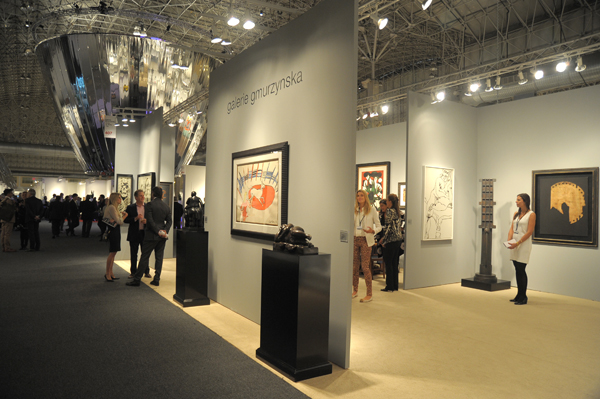
Vernissage, Expo Chicago. Image courtesy of Carol Fox and Associates Public Relations, 2012.

JL: What’s your vision for the future of this fair, both next year and in the long run?

TK: I think that we continue to build a collector base that marks their calendars for September, and deepen our linkage with the institutions. I’d love to see a full-on alignment with both the Art Institute and the MCA with mega exhibitions. I think that there’s a whole host of ways in which we will all benefit when the fair happens.

My vision too is we serve the greater ecosystem of Chicago in a way that there’s even more involvement with those that come to our city and those that go out and see galleries, performing art institutions, all of it. I think that this Expo week of activities generates a wonderful umbrella for a lot of companies, artists, institutions, galleries, etc. to provide programming that makes it a great experience. I know that the CSO Muti concert that took place during the fair—that kind of collaborative effort is a reason for someone from a Lincoln or St. Louis or New York or Kansas City or wherever to come to our city, and I’m hoping that more collaborative programming can be heralded. So it’s a big week for the arts in Chicago. That’s a bigger vision. I think that there’s a lot more that we can do to foster that.

JL: What is your next step?

TK: The wrap-up and the ramp-up occur simultaneously. I’ve been working as hard now as I did a few days before the fair and at the fair; it really doesn’t stop. My next step is making sure that we build an extraordinary gallery list again.

I think that my next steps are really looking at greater outreach; we want to make sure the whole team is focused on communicating to the regional museums, curators, directors, and trustees of those museums that they need to mark their calendars for Chicago, and that’s a big initiative for us.

There’s a lot of follow-up on a number of our sponsors. We are very grateful for the collaboration with Northern Trust this year, and we would expect to build upon that, as well as the other sponsorships that we developed this year, like Mercedes-Benz, etc. There’s a lot of follow-up that takes place just because we have to find out who wants back in and who doesn’t.

It’s an exciting time. We formed a civic committee relatively late because it was an initiative that took several months to organize. We expect to organize a civic committee meeting sometime in November and that will also help us do some broader planning. We want to make sure the exposition has a foundation within the civic and business initiatives of our city, and I think that that first meeting will open up some opportunities for us.

But the most important thing is that we’re back. Our dates are September 19-22 next year, and it’s no secret that we’re moving forward and looking forward to next year.

JL: I know people are definitely looking forward to it. The response has been pretty amazing.

TK: Yeah, and I think that that reflects our city. It’s great to have been a part of a big city effort to make sure that a fair in Chicago looks, feels, and is what this city deserves. I’m grateful for the positive response but also not going to rest on any laurels, because everything has to continue to refine and grow. It’s time for this to happen.


For more information about Expo Chicago, visit www.expochicago.com.

This article was originally published in Sixty Inches From Center.

Friday, October 12, 2012

How Art Moves // “When was the last time you went streaking?”


On Wednesday I had the pleasure of attending the Chicago Ideas Week “Art: How It Moves” talk, which explored how art can be used “as a medium for good, a method for inspiring change,” and “a symbol of protest.” My kind of talk.

(Thanks to birthday twin Nathan Stanton, former I CAN DO THAT artist, for the ticket! And thanks for being such a fun person to sit next to!) (On top of some hilarious commentary that wasn’t always quite under the breath, he’d cheer for each speaker as if we were at a football game [not that I would know /art nerd], which, really, is how everyone should react to art.)

Petra Bachmaier of Luftwerk, showing off Luminous Field.

I liked what multimedia artist Phil Hansen had to say after tricking the entire audience into tearing apart his work (gasps ensued):


“We can’t create without destroying, and we can’t destroy without creating.”

and what Naomi Natale, Founder of One Million Bones, a project that acts as a “symbol of our human connection, our humanity, that we belong to each other,” had to say about the power of art:


“Leaving an indelible mark on one’s soul [is] what the greatest art does.
[With art, we can] imagine a different reality is possible.

Photographer Carlos Javier Ortiz shifted the focus from global crises back home, back to our backyards, with his stirring “Too Young To Die” project, which brings attention to youth violence in Chicago. Aside from addressing the problem in ways the mainstream media won’t, the project also looks at resilience and strength, and aims to teach young people to communicate through art. Check it out.

Other speakers included Donna Cox, who discussed the intersections between art and science (be still, my heart); multimedia artist Petra Bachmaier of Luftwerk, the folks responsible for the wondrous Luminous Field installation at the Bean; and Carter Cleveland, Founder of Art.sy, which launched to the public on Monday.

I live-tweeted the event here (scroll down a little). All relevant tweets are tagged with “CIW” and run the gamut from inspirational quotes like the above to things like… thisYep. (The title of this post is also a direct quote from the talk. Well, artists do bare all.)

Chicago Ideas Week runs through the 14th—if you’re in town, I’d strongly encourage going to at least one event. Be inspired!

Another former I CAN DO THAT artist, Chris Barrett, asked me to help him with his new portrait photography endeavor a few days ago, and I was happy to oblige / sit awkwardly and be unsure of what to do with my hands, oblivious to the fact that these were, like, super close-ups. I’m using one of his photos on the “About” page and on my profileI CAN DO THAT Family forever!

Monday, October 8, 2012

I got 99 Luftballons but my art ain’t kitsch


Walk into a studio; this ends up happening.


(Hurrah for spontaneous photo shoots / Like Say Anything but with lion heads.)

Thank you to those who came to Saturday’s art party! Missed it? It’s happening again on Saturday, October 20, from 6-9pm at Tocco (1266 N. Milwaukee Ave.).


Photo by Tomasz Niemiec, 2012.

If you’re on Facebook, you can join the event page here.

Saturday, October 6, 2012

Fire Rabbits, Water Dragons


Chicago Artists Month has begun, and Art Depth is today! If you’re in Chicago, be sure to drop by, and don’t miss my balloon launch at 8pm. Besides the art party I’m throwing, there will be much more going on at the event. Here’s the full schedule. It’s a packed one.

In other news:

I’m on the TRANSIT Map as one of the artists! Here’s the full-size version. You can also pick up a physical copy of the map at any of the local businesses listed, found throughout the Logan Square and Avondale neighborhoods. I definitely cheated with the three medium limit / parentheses are my friends.

Yesterday I met up with Expo Chicago Founder / President / Director Tony Karman again for a follow-up to my original interview. Stay tuned for the continuation and learn about the inaugural exposition’s aftermath and future.

And:

When your ideas and creations take on a life of their own, without you, outside of you, transforming into beasts people talk and think about long after their realization, you know you’re on the right track.

Monday, October 1, 2012

Fall into place // Rocktober


Hope you’re enjoying the fruits of fall! The figurative ones. Because the literal ones are impossible to enjoy given their antecedents. (Blueberries are out of season now? Go away, squash.) I’ve been keeping myself quite busy (my natural state):

Did you get a chance to check out Expo Chicago a couple weeks ago? Unlike the Dark Knight, it was the international contemporary art fair Chicago deserved and needed. My interview with Tony Karman was picked up by The Seen, the exposition’s official blog, and I covered the Vernissage opening night private preview; you can view photos of my highlights on Facebook and Flickr.

Over the weekend, I guested on the O.C. Dweeb nerd podcast. The hosts and I talked art and geekery and kept getting into long tangents about Batman (I’m beginning to sense a trend). We also may or may not have been drinking whiskey out of Styrofoam cups. The podcast will air this Wednesday, October 3, at http://ocdweeb.com.

Most importantly:

Art Depth. Image courtesy of Cheryl Postrozny, 2012.

This Saturday, October 6, I will be a Featured Artist in Art Depth’s 3rd Annual Interactive Art Party and Black Water Dragon exhibition, both part of Chicago Artists Month. Now, I could’ve used this as a chance to, you know, show my own artwork, as artists tend to do when invited to participate in art shows. But that just wouldn’t be my style, man. So, naturally, I’m throwing my own interactive art party.

You might recall when I mentioned my postcard project, in which I mapped the dreams of a city.

I’m bringing this labor of love to Chicago, and it’ll be even larger in scope this time around. Saturday marks its official launch.

I invite you all to come and share your dreams (anonymously, of course, unless you want to reveal your identity), via image, text, and / or any other method of self-expression. These dreams will not only be displayed throughout the duration of the exhibition, but will also be part of a year-long project, culminating in a large-scale installation, show, and book.

In addition to sharing dreams, guests will be invited to let go of their fears, literally. There will be balloons on which guests can write / draw the things that are holding them back, and towards the end of the night, we’ll release them into the sky.

If you have a Facebook account, invite yourself to the event page.

(The details if you are Facebook-less:
Mautene Court
1264 N. Milwaukee Ave.
5:30-8:30pm)

Also, I’d like to say that I was just (like, within the past hour as I type) paid a great compliment by composer Renee Baker, who called me “a free spirit” and explained that “It’s encouraging to see that not all creativity and spontaneity is drummed out by a greedy system.” Thank you, Renee. You made my day.

Bonus email exchange excerpt (also within the past hour):

“The idea is to get messy without having to be naked.” –Caitlin Bergh

(Kind of tempted to leave that context-less.)

(Brainstorming possible performances for the party.)

Tuesday, September 18, 2012

EXPO CHICAGO // An Interview with Tony Karman

Studio Gang's design for Expo Chicago. Image courtesy of Studio Gang, 2012.

This week, the art world’s glitterati will descend upon Chicago for a new contemporary art fair: Expo Chicago, The International Exposition of Contemporary/Modern Art & Design. Occupying Navy Pier’s colossal Festival Hall, the fair showcases a selection of top tier galleries—capped at 100—from around the globe. Also included are EXPOSURE, a section comprising younger galleries; IN/SITU, a presentation of large-scale installations and site-specific and performative works; the conclusion of /Dialogues, a series of panel discussions and conversations; and a VIP Program.

Designed by the architecture studio of luminary Jeanne Gang, the fair’s floor plan mimics Chicago’s grid system, boasting gallery-lined streets that allow visitors to view everything in sequence without losing their way, as well as a diagonal avenue on which visitors can view select exhibits and installations. Hanging from the hall’s high ceilings are mammoth mirrored cones.

While many may be curious as to whether Chicago can live up to the challenge of hosting such an event, some involved in the lively local art scene have a separate concern: Can the fair get out-of-town collectors to patronize Chicago’s talented artists, to venture beyond Navy Pier and see all that this city has to offer? However, as easy as it is to be skeptical of such an undertaking, especially with the demise of Art Chicago last year, Expo Chicago looks promising.

For one thing, Tony Karman, the fair’s President and Director and man with a vision, actually listens to what the local art community has to say, adding programming that directly reflects community suggestions to better bridge the gap between the peripheral art scene and the ostensibly distant universe of art trade shows. Unsurprising it is, then, that the exposition has so much support. This may very well be the art fair that rightfully represents and shows the city off to the world. Expo Chicago is something to get excited about.

I sat down with Karman for a preview of the fair. What follows below is our conversation.

Expo Chicago runs from Thursday, September 20, through Sunday, September 23, with a Vernissage opening night preview on Wednesday, September 19.


Navy Pier. Image courtesy of Carol Fox and Associates Public Relations, 2012.

Jenny Lam: First of all, how are you?

Tony Karman: Oh very well. We’re in good shape!

JL: Hectic?

TK: Good-hectic.

JL: Since this is the inaugural exposition, how will Expo Chicago distinguish itself from the more established international art fairs such as Art Basel?

TK: I think the city is, most importantly, the differentiation point. We have a great legacy in Chicago for an extraordinary international contemporary and modern art fair for 21 years. Beginning in 1979, Chicago was the preeminent art fair city in North and South America, so there’s a great legacy to build upon.

But in this case, I think our differentiation is the date, which is a great time for the international art community to open up a contemporary and modern fair in America.

Our differentiation point is going back to Navy Pier, the venue that was, in fact, built for it. Festival Hall was really established based on the strength of the original fair, which was called the Chicago International Art Exposition.

And then the other differentiation point is—and I’m very public about saying this—quality, not quantity. Although we share many galleries that do Basel, I would expect that the quality of the fair continue to shape and grow. Obviously we’re very proud of the list as it was presented, and I would venture to say that a good deal of the international art world—dealers, collectors, art enthusiasts—are actually coming for all the right reasons to check us out.

JL: Is that emphasis on quality and not quantity the reason why you’re limiting the list of exhibitors to 100?

TK: Yes. I limited the list to 100 stands. Now, if you do the math, several galleries partnered and then we added the Exposure section of galleries five years and younger, we have seventeen galleries there. For the main fair, I limited it to 100 stands. But I did that for two reasons. One, to make sure the quality level was high; and two, I’d rather take the long-term approach on this fair and make sure we provide a greater opportunity for the exhibitors to do well.

I think that, ultimately, any fair is great at not only on how respectful you are of the artwork that’s being presented and building a venue that reflects that, but also providing as much an opportunity for art exhibitors, art dealers, participants, to actually see who they want to see and sell artwork to those clients.

Festival Hall in Navy Pier. Image courtesy of Jason Pickleman, 2012.

JL: How are you striking a balance between shining a light on local artists and dealers and bringing in the international crowd?

TK: You know, I’ve always believed that the exposition should serve the greater ecosystem of the arts community in Chicago. And by that ecosystem I really mean the schools, the institutions, the galleries, the artists that are here. There are twelve galleries from Chicago participating in the fair. If we do our job right, the attendees—the patrons that come and visit our city—will get out to explore all of what’s happening in our institutions and our galleries. I want to make sure that we serve that broader community as well as we possibly can. We’re encouraging patrons to take that step to explore. We’re providing shuttles Thursday, Friday, and Saturday to both gallery districts and the MCA. Those are ways that we can provide a greater opportunity for art enthusiasts to explore.

JL: When I think of art in Chicago, the first thing that comes to mind is its more alternative art scene, which, in my experience, is very vibrant. Are you striking a balance between that kind of experimentation that is characteristic of our city—like we’re seeing with the MDW fair—and the more established galleries?

TK: Yeah, you know, I think that the MDW fair, with the apartment gallery scene… that’s a vibrant, vibrant voice in our city, and I think that’s extraordinary. I know that there are a number of galleries that are opening and have opened because it’s the beginning of the season, but they’re also doing a number of special events to take advantage of that activity. I think any great fair activates the broader community in ways that allow everyone to benefit.

I think that it’s important—let me speak to the artists in our city—that the artists in our city find ways to take advantage of this as well. There’s a whole host of individuals we believe will be coming and may not have been: curators from regional museums, collectors from the greater Midwest, collectors from the coast, curators from around the world. I think that, once the buzz continues, they’re going to be, just through that wonderful communal network, exposed to a lot of what’s happening in our scene. And I’m extremely hopeful that what happens is that everyone benefits: the alternative gallery scene, the gallery scene, the artists, through connections, whether it’s a party, whether it’s an event, whether it’s someone coming into a space, whether it’s at Navy Pier. When you bring that energy together, you can’t help but know that you’re fostering something in the future.

Studio Gang's design for Expo Chicago.
Image courtesy of Studio Gang, 2012.
JL: How would you compare what Rahm Emmanuel has done so far in terms of advocating for the arts versus what Richard Daley did?

TK: You know, I think that there hasn’t been a mayor in our city that hasn’t recognized the value of the arts. Mayor Daley was extraordinary. Not only in Millennium Park, but we have a great legacy of support for institutions in the arts. Stepping a little bit before, [there’s] Mayor Harold Washington; it was under Mayor Washington that the first Cultural Plan was executed. And I think that spoke volumes to that mayoral commitment.

To respond to the current, under Mayor Emmanuel, the revision of that Cultural Plan—the one that was done thirty years ago—was just announced and presented, and you see a mayor that really understands the role of the arts, not only in education, which we see now that’s instituted back into schools [with] arts education, but also what the role of the institutions, galleries, performing arts, and theatre does for our city to really burnish a great international reputation. It’s obvious that Mayor Emmanuel understands not only the importance of this fair, but we’re one small cog in an extraordinary collection of institutions and events and organizations that says to the world, “Hey, come to our city; we understand what the arts are, and we understand what a vibrant cultural city can be.”

JL: You yourself are a veteran in the world of art fairs. But what I love is that you started off as a security guard at the Chicago International Art Exposition back in the 80s.

TK: That I did!

JL: How did—or does—that affect your love of art, and what from that early experience did you bring to this new endeavor?

TK: You know, in college my degree was Fine Arts and Literature. I always did production in college, for concerts. So when I moved here, it was, one, an opportunity to be a part of something extraordinary, something that I would hope to replicate with Expo Chicago, because it was an immediately clear that it was important to the world; and, two, I had made myself indispensable to hopefully take advantage of that production side of me, and that want and yearning to make sure that it’s time to put on another event.

I love what events can do, not only for myself because I love to see what one can create, but just the extraordinary amount of support, efforts, partnerships, and presentation that form that nucleus that ultimately results in something, and the something of an Expo Chicago, if you move to this year, is an amazing generator.

For me, I didn’t expect, thirty years ago, to be doing this. It was not a part of my life charter. “Gee, I hope I can someday do an art fair!” But it’s a fascinating time for me because I can use much of my past in ways that can benefit this fair. My role in the performing arts community, or in the city, or having a company that did sponsorship in marketing, or… all of those things really can be brought to bear in this moment. I’ve never missed an art fair in Chicago, I’ve been involved in many of them, and I think that this is my chance to glean a bit from all of that and start a new chapter.

Tony Karman. Image courtesy of Carol Fox
and Associates Public Relations, 2012.
JL: Speaking of your involvement in Chicago’s art fairs, you used to be the Vice President and Director of Art Chicago. How will Expo Chicago differ from Art Chicago?

TK: I think that it differs by virtue of time, it differs by virtue of location, it differs by an extraordinary selection committee, an extraordinary inaugural year exhibitors list… all of those things. I think that I’m grateful for the support of our institutions, the Museum of Contemporary Art, the Art Institute, the Smart Museum, the [Renaissance Society], all—I could go through the whole list—our top collectors in the city that are civic leaders, are business leaders, Mayor Emmanuel, that recognize that this was important, that this was something that should be supported.

And I think that, rather than say it differs, I think this is just a new chapter, and we’re the beneficiaries of a great deal of hope, because obviously you’re interviewing me prior to; and post-hope, a long want and yearning for our city to host a fair every year.

JL: If someone wants to know why or how Chicago is a world class city, what would you say to that person?

TK: Oh, unequivocally! Look what we have. We have institutions that are respected throughout the world. We have a city that is unmatched in its beauty and its layout. Numerous corporations are based here. This is a world class city in every way.

It’s also a world class city in the way the makeup of the fabric of the city is represented. I don’t know of many cities that you can go and literally travel the world like you can do on Devon or Pilsen. You can find every wonderful ethnicity in the world with a pocket of newly fresh immigrants. I’m Greek; my family came here in the turn of the century. I think Chicago has an extraordinary blend, an extraordinary fabric, and I think it’s the people in the city that make up what you just said about being world class.

I’ve been grateful to be an ambassador for the city, as well as this project, for over fifteen months. And there is not a city in the world that doesn’t respond positively to what is happening, specifically now in our art world, to what is happening at the MCA, with a curator core that is on fire; to the Art Institute, with a curator core and exhibitions that are beyond notable, with the Lichtenstein [exhibition] that just took place and others announced; the Renaissance Society for its long legacy of support… It goes on and on and on.

In our world, Chicago means something, and the support for Expo Chicago means that the world recognizes that. The response that we’re getting is really due to the extraordinary aspects of our city.


For more information about Expo Chicago, visit www.expochicago.com.

This article was originally published in Sixty Inches From Center. 

Monday, September 10, 2012

Outside the 7-Eleven


So I’m walking down Milwaukee Avenue late at night and this guy stops me. “Excuse me, darling. Do you like Ghetto Art?” He’s wearing a newsboy cap, a suit jacket, and a rosary. (I’ll later learn that he goes by Sir Gerald, and he hails from Las Vegas, and he’s here with his mom. She’s standing a few feet away with a flower in her hair, and later she’ll tell me I’m “too cute” and ask me if I’m Korean. Nope.) “Yes!” I answer enthusiastically (because that’s the only way you should answer a question like that). He shuffles through a stack of illustrations he’s made. The first one is allegedly a drawing of Beyoncé, captioned with “Bootylicious,” except bootylicious is, like, totally spelled wrong (there’s definitely at least one extra “s” in there). “You can make a donation of any amount,” he begins, but I cut him off and go, “Actually, how about we trade? I’ll give you my art for your art.” He hesitates at first, but I hand him a piece of a large interactive project I’m starting and will continue for one year. He takes it, looks at it, and, although he was already amicable before, his demeanor changes. He’s beaming. He looks me in the eye and, smiling, says, “This… is powerful. Thank you.”

Art, guys. Art.

Thursday, August 16, 2012

Leo Rising


And I’m back! Physically, mentally, metaphysically, metaphorically, metabolically… For this post, I’ll use bullet points. Because I can. I’ll also say because today’s my last day of being 24. Which means within 24 hours I’ll be able to… rent a car? (As if I weren’t already reluctant about this whole propelling myself forward through time thing, there’s no better way to make a young person feel prematurely and unreasonably old than marking an alleged milestone with the lamest legal liberty possible.) Amurrica!

  • I’ve been invited to be a Featured Artist for Art Depth, part of Chicago Artists Month. Save the date: October 6!

  • I recently wrote an article for Sixty Inches From Center in which I chatted with the Q4 Tribe, an independent art collective with a focus on social activism. Now. Allow me to quote myself. (Because I’ve lived for a quarter of a century, damnit!)

It’s hard to interview nomads when you’re trying to squeeze through dancing multitudes and libations are streaming forth and a fusion of hip hop and world music is blasting and you’re in the middle of an atmospherically lit space covered wall-to-wall in colorful murals with slogans ready to rouse revolution within you. Then again, the thought of interviewing the Quennect 4 gang didn’t really occur to me then, almost a year ago when I first stumbled upon MultiKulti. All I knew was that they were a great group of people to party with.
Since that time, however, I’ve found that if you’re even at least slightly active in Chicago’s underground art scene—particularly the scene that is, refreshingly, dominated by people of color—you’ve most likely come across someone or something with ties to Q4.
An independent art collaborative, Quennect 4 is a grassroots force to be reckoned with. Everything from organizing alternative festivals that help community organizations (their last Block Party, held this past weekend, benefited Street-Level Youth) to providing myriad platforms for artists and musicians to showcase their talents and passions (such as hosting an Open Mic series every last Thursday of the month), the Q4 Tribe dedicates itself to supporting local artists, activists, and educators and focuses on all things creative and socially conscious.
On one of those hot end-of-July days when the air itself seemed to cling to your skin and you broke into a sweat just strolling down a shaded Milwaukee, I sat with Amara Betty Martin in the backyard of RGB Lounge, the sounds of construction down the block and the L rumbling past overhead providing periodic moments of respite, allowing us to collect our thoughts and contemplate each other’s words as if sipping on cold beers—the quintessential Chicago summer afternoon.

Read the full interview here and revel in some wonderful nuggets of wisdom from Amara, like “Through art, everybody can find a universal connection.” And while you’ve got SIFC on your mind: the organization is looking for more writers, photographers, and filmmakers.

  • If you’ve been keeping up with my art travels, you’re probably expecting the post about Hong Kong / art and social class that I hyped up (oops). I had a really, really lengthy (like, pages and pages on MS Word), really, really personal (like, more so than the 3rd culture kid post) piece that I’d typed out en route from Zürich to Basel, rolling through the scenic Swiss countryside, but I ultimately decided against hitting “publish” because… of the two characteristics I just mentioned. I will, however, probably release a revised version. I’ll also be sharing insights about the European leg of my adventures, e.g. comparing Art Basel with ART HK.

Basel, baby.


  • Check the side bar for a list of social networking sites I use, my most active account being Twitter (followed by Google+ and LinkedIn), which I update daily. (Well, really, I’m the most active on Facebook, but if we don’t know each other in real life / are not likely to meet each other in real life, I tend to curate* which friend requests I accept, and it’s nothing personal. Anyone and everyone, however, can feel free to subscribe to my public updates.)

*Kidding. Please don’t use the word “curate” like that. Ever.

Related Posts Plugin for WordPress, Blogger...